

Opportunity for Canadian Leadership
BIOTECHNOLOGY AS A STRATEGIC ECONOMIC ASSET
Canada’s biotechnology and life sciences sector has long been a player on the world stage, and today that role is gaining new momentum. In a global market increasingly shaped by mRNA, gene editing therapies, and the application of AI, Canada is at the forefront of the next wave of innovation. Recent federal commitments and announcements have reinforced the sector’s growing importance to the country’s economic future. Federal initiatives, including the new Pharmaceutical and Life Sciences Sector Task Force, Canada’s National Artificial Intelligence Strategy, and Canada’s Defence Industrial Strategy reflect a stronger recognition that life sciences is not only central to better health outcomes, but also to Canada’s industrial capacity, national defence, and long-term economic growth.
Commitments related to investment, intellectual property protection, dual-use technologies, and regulatory modernization reflect a broader understanding of what it takes to help Canadian companies grow, compete globally, and anchor more value at home.
At BIOTECanada, our focus remains on the two pillars that matter most to the sector’s long-term success: access to investment and regulatory modernization.
Canada’s opportunity now is to build on its existing scientific and commercial strengths with a policy environment that enables companies to grow here, compete globally, attract investment and anchor more economic value in Canada.
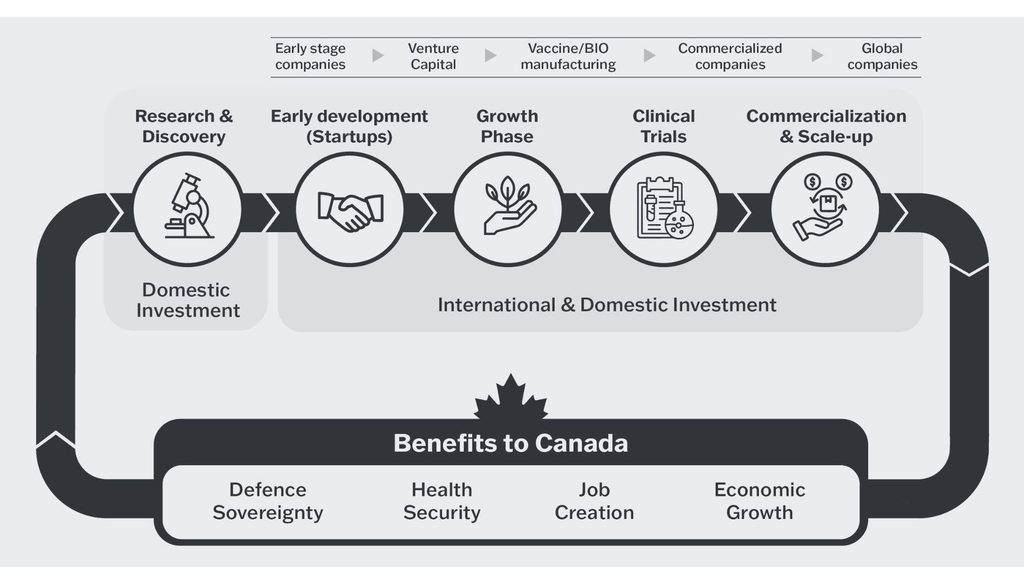
The Canadian biotechnology ecosystem is comprised of clusters in each province which bring together world-class universities and research institutes; biotech entrepreneurs; large multinational players; and a highly educated workforce. A strong life sciences sector depends on a full policy continuum—from early-stage research supported through investment, to scale-up through private capital and a modernized regulatory system to support commercialization (see Figure 1). In order to capitalize on those assets, Canada must strengthen that continuum, helping companies grow in Canada, attract global investment, and anchor more of the value chain at home.
Figure 1. Canadian Life Sciences Ecosystem and Continuum
COMPETING FOR INVESTMENT, GROWTH AND ECONOMIC VALUE
The life sciences sector in Canada has been a financial driver with more than $30 billion of investment in recent years, while serving the health of the Canadian population. Competitively, the world looks to the Canadian sector for the quality of the research it generates and the highly skilled labour force that supports sector growth. These prized assets are the cornerstone of how the Canadian industry is looking to expand its value and grow operations in Canada. The core opportunity for the sector lies in its ability to translate world leading scientific discovery into commercial products, attract investment from within Canada and from international investors, and operate within a comprehensive regulatory regime enabling those products to reach the market as healthcare solutions in a timely manner.
This is an extraordinary moment for the sector as 2026 unfolds with unprecedented policy directives emerging from the United States.
At the same time, advances in genomics, CRISPR, and AI are reshaping the development of new therapies and creating new economic opportunities for countries able to capitalize on them.
Canada has a long history of being at the forefront of medical innovation. Insulin is a point of pride, but there was also whooping cough research and the Toronto method for the polio vaccine. Today we’re leading in radiopharmaceuticals, genomics, cell and gene therapy, regenerative medicine, and AI-driven drug discovery. Capturing the economic value of these strengths requires stronger capital pathways and more competitive routes to market.
A SHIFTING GLOBAL ECONOMIC ENVIRONMENT
As the national industry association representing the life science ecosystem in Canada from research and discovery, through to commercialization, BIOTECanada has been working with our national network to determine impacts related to the recent actions taken by the White House. Like other strategic sectors of the Canadian economy, the existing value and future potential of the life sciences sector is exposed to a rapidly changing and increasingly competitive global environment.
Continued implementation of federal investment and regulatory initiatives in biomanufacturing, life sciences, and Health Emergency Response Canada (HERC) is important to Canada’s economic competitiveness and domestic capacity. However, the geopolitical environment now demands additional measures to safeguard the sector and address gaps in the life sciences ecosystem.
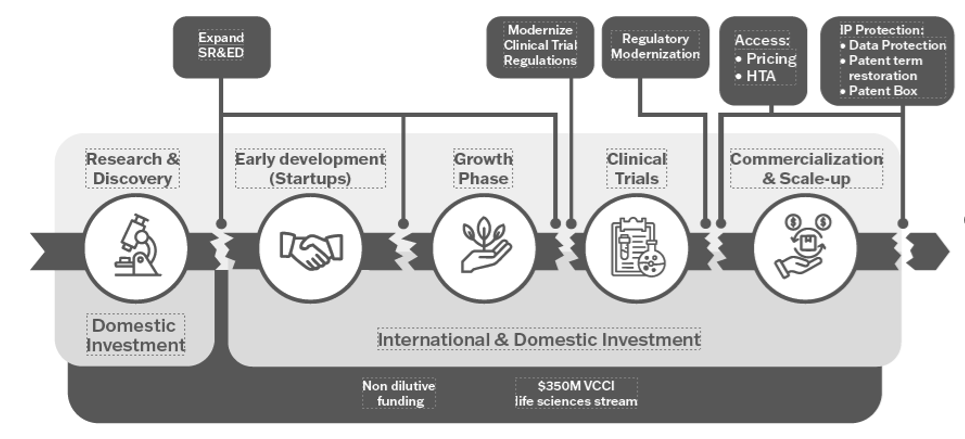
BIOTECanada’s federal budget recommendations for investment and improvements to Canada’s regulatory systems will help create a more competitive domestic environment, attract and retain investment, and support the growth of Canadian life sciences companies. Fixing the gaps identified in Figure 2 will strengthen economic and health sovereignty at a time of unprecedented competition for the next generation of life sciences technologies, platforms, and products.
Figure 2. Gaps in the Canadian Life Sciences Ecosystem and Continuum
The federal government has already recognized the strategic value of life sciences through initiatives including the creation of the HERC and Canada’s biodefence industry strategy. Budget 2027 is an opportunity to build on that foundation and ensure Canada can compete for the investment, companies and highly skilled jobs that will drive the next generation of biotechnology growth.
BIOTECanada offers the following recommendations:
1. Increase access to investment capital
New investment and government support are key to ensuring that emerging companies can access capital that allows them to move along the development continuum. BIOTECanada welcomes the recent $150M life science fund from the Business Development Bank (BDC) and the previously announced Venture Capital Catalyst Initiative (VCCI). The sector requires additional dedicated non-dilutive allocations for life sciences from the Government’s announced $750M growth vehicle. Initiatives to mobilize pension funds are likewise timely and important.
Recommendations:
- The government should implement the Life Sciences Venture Capital Catalyst Initiative (LS-VCCI), a life sciences venture fund as quickly as possible to sustain a competitive life science sector.
- Canada should commit additional budget to non-dilutive investment for life sciences.
2. Establish a competitive tax environment for emerging, start-up companies developing technologies vital to long-term economic growth
A competitive tax regime which includes an IP box mechanism encourages companies to commercialize their IP in Canada and increases the likelihood those companies will further invest and remain in Canada once they are commercial. In the long term, the creation of jobs and company earnings will provide additional tax revenue for the government that would not exist if a company left to commercialize in another jurisdiction.
Importantly, a reduced corporate tax for R&D companies in Canada should be implemented as soon as possible and not delayed. High value Canadian biotech companies that are not yet commercial are making decisions now on where to invest (e.g. clinical trials, manufacturing) and where to headquarter on based on which jurisdiction offers the greatest opportunity to extend investment capital. For those companies, the implementation of an IP box when coupled with a strong SR&ED tax credit would be a significant incentive for companies to locate IP and operations in Canada.
Recommendations:
- Create a Canadian patent box to protect and retain the value of domestic innovation.
- Work with industry to identify areas for further expansion of the SR&ED credit program to cover innovative or emerging technologies, which would significantly help to maintain Canada’s competitiveness as global developments occur.
3. Improve regulatory performance and alignment with global standards
An effective regulatory environment ensures safety while encouraging the introduction, acceleration, and adoption of biotech innovation. A high-performing world-class regulatory system that is predictable, efficient, consistent and transparent, is key to ensuring Canadians’ access to biotechnology innovation and clinical trials. A competitive regulatory system will accelerate the growth of Canadian companies and facilitate the attraction of innovation to Canada for Canadian patients.
Canada’s ambition to be a world-leading regulator is key, particularly as new technologies such as mRNA, cell and gene therapies, gene editing, radiopharmaceuticals and artificial intelligence are developed and deployed.
Health Canada significantly updated and increased the cost recovery fees charged to companies to review submissions in past years and continues to increase fees on an annual inflationary basis to address the volume of work as well as added complexity from globalization, technological advancement and more sophisticated data and systems such as artificial intelligence (AI). Predictable regulatory performance is vital to meeting the needs of Canadians and health innovation.
Recommendations:
- Health Canada must continue to be adequately resourced to improve the health and safety of Canadians by delivering key services and strengthening the implementation of modernized regulations.
- Canada must strengthen approval timelines to match best international practices, expand rolling review models, and increase reliance and collaboration on trusted foreign regulatory authorities to support predictable science-based decisions.
4. Modernize intellectual property protections
For an early-stage biotech company, intellectual property is at the core of the company and its economic value. Importantly, translating that IP into products that reach patients requires significant time and investment capital.
The complexity of the IP and time needed to take it from the lab into commercial use requires both significant investment capital and also investors who have the knowledge and ability to invest in these complex companies over the extended period required to undertake clinical work and meet regulatory requirements. For this reason, biotech requires specialized investors with the expertise and patient capital needed to support long development timelines, and the global landscape for investment attraction is highly competitive.
A strong and competitive IP policy regime is fundamental to attracting global investment. In this context, to remain an attractive investment destination, Canada must at a minimum ensure that we do not fall out of step with other like-minded jurisdictions. Being uncompetitive in this regard will reduce the availability of investment and correspondingly force companies to take their IP and innovations to other jurisdictions that are protective and respectful of IP rights and patent protection.
Recommendations:
- Extend data protection to ten years as a means to provide appropriate protection for the large investment and regulatory burden involved in bringing new products to market and in order to encourage companies to bring such products to market in Canada in a timely manner.
- Expand patent term restoration timeline and the government‘s implementation framework to meet the intended benefits for patentees taken by CUSMA signatories to support companies establishing and launching products in the Canadian market.
5. Implement a more competitive evaluation framework to appropriately value innovation and secure the best possible therapies to address the needs of Canadian patients.
A set of unprecedented policy directives emerging from the United States carry serious implications for Canada’s biopharmaceutical and broader life sciences ecosystem. Recent U.S. tariff announcements on pharmaceuticals, along with new Executive Orders invoking Most-Favoured-Nation (MFN) pricing principles, pose risk to Canadian companies, supply chains, and patient access to essential medicines, as well as to the viability of the Canadian market.
Recommendations:
- Reinstate the United States as a reference country for the Patented Medicine Prices Review Board.
- Ensure health technology assessment agencies integrate higher willingness to pay benchmarks in valuing therapies and enable provincial review bodies to increase predictability and support earlier product launches.